Learn · six written lessons · Zonetta Trading
The candlestick course
Six written lessons on reading Japanese candlesticks — from what a single candle records to the place on the chart that decides whether reading it was worth anything.
Six written lessons · also on video · free, and it asks for nothing
01 / The course
What this course is
Status: Six lessons written
Four pages about candlestick reading. Nothing is behind a wall, nothing asks for an email address, and no part of it is a sample of something paid.
The reason it exists is that almost every candlestick lesson in circulation was written for spot foreign exchange, and a Nasdaq-100 futures chart does not behave like a currency pair. A formation that means something on one instrument can be noise on the other, so the course measures every pattern against the instrument’s own recent range instead of a distance borrowed from somebody else’s chart. That is the only part of this subject where I think there is anything left to say.
It is written for a trader who keeps getting caught by the candles that look decisive and are not. If you do not know what a candle is yet, that is fine — lesson one starts at the beginning and assumes nothing.
Read them in order. Each lesson is built on the one before it.
Diagram · the whole course on one plate
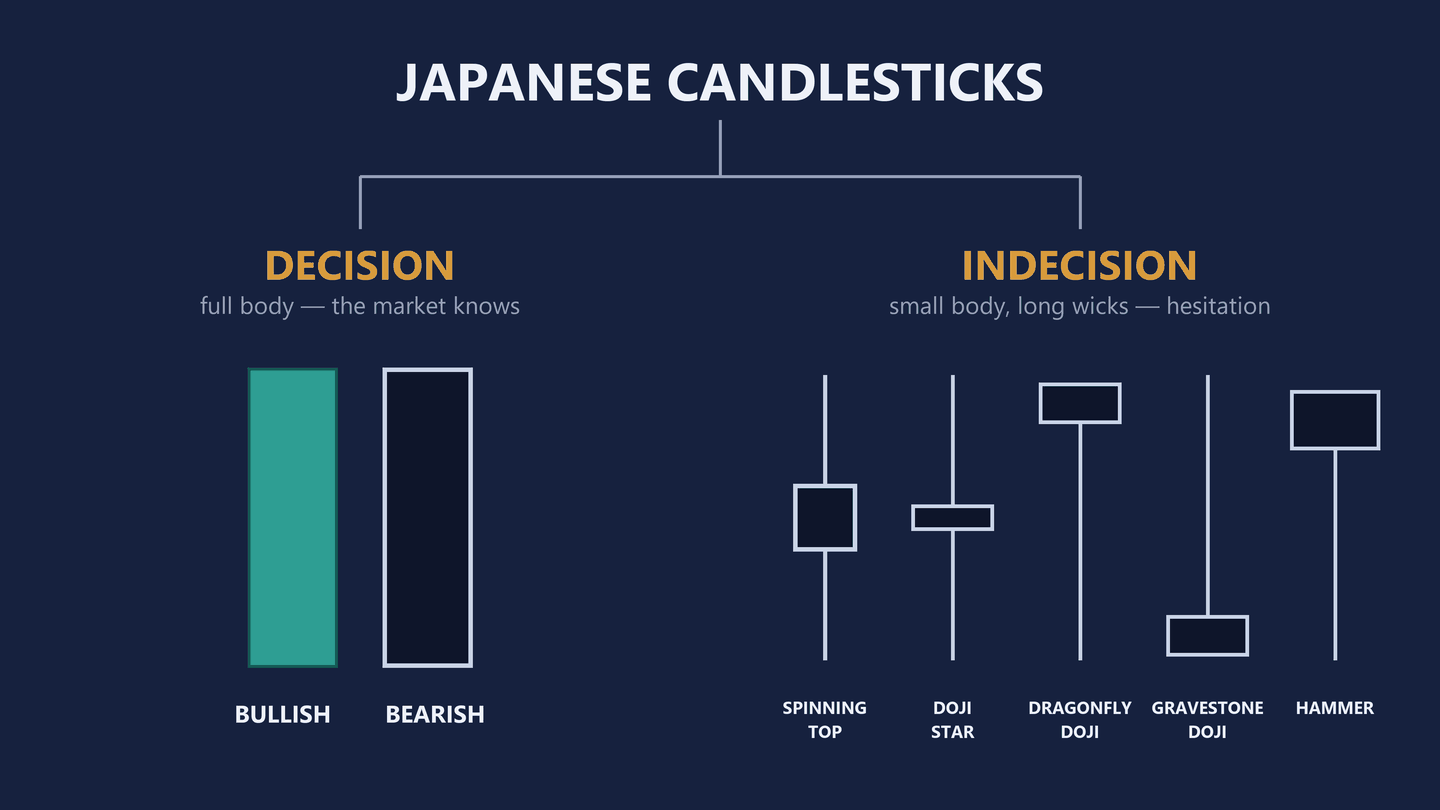
Diagram only · no instrument, no price, no outcome claimed
02 / The lessons
The six lessons
One page each, in this order.
- Lesson one
- How to read a candlestick — where the notation came from, the four prices a single candle answers, and the two families every candle belongs to.
- Lesson two
- The candles that mean doubt — the shapes that mean neither side won the window, and why each of them is a warning rather than a direction.
- Lesson three
- The six formations worth keeping — the multi-candle formations that survived the cut, and the reasoning for throwing the rest of the deck away.
- Lesson four
- Entry, stop and target — turning a formation into a written decision: where the entry sits, where the stop sits, and when the honest answer is to leave the trade alone.
- Lesson five
- Find the formation — ten charts with the labels taken off. Name the shape that closes each one, then open the answer. Two of the ten are traps.
- Lesson six
- Where the candle is standing — what a supply and demand zone is, how to draw its two edges, and why the same shape means different things in different places.
A candle does not tell you what happens next. It tells you what just happened and which side had to give ground doing it. The whole course is about deciding when that is worth acting on.
03 / On video
The same course, narrated
6 videos
one playlist
All six lessons exist as videos on YouTube, narrated in English and shot as full-screen diagrams rather than a talking head. For the first four the videos came first, and the pages are the written version of them. Lessons five and six were written first and filmed afterwards.
Lesson five is the one that changes shape between the two. On video the clock runs and you answer or you do not; on the page you can stop, go back and argue with it. Both are the same ten drills. If you want the version that waits for you, read it.
If you would rather be talked through it, the links are below. Where a video and a page disagree, trust the page — the written lessons are the ones that get corrected.
- Lesson one
- The 300-Year-Old Code Hidden in Every Chart. Published .
- Lesson two
- The 9 Candles of Doubt (Read Them or Get Trapped). 10:14.
- Lesson three
- Only 6 Patterns Actually Pay (Learn All Six). 9:32.
- Lesson four
- The Complete Trading Protocol (Entry, Stop, Target). Published , 11:24.
- Lesson five
- Train Your Eye — Find the Pattern in 10 Seconds. Published , 7:25.
- Lesson six
- Candles Are Tiny Zones (The Bridge). Published , 10:35.
- Full playlist
- CANDLESTICK — The Free Course, in order, on YouTube.
04 / The companion
The printable companion
Five printable pages that go with the course: the candles that mean doubt, the six formations that survived the cut, the protocol for entry, stop and target, and the swing definition the rest of it hangs off. It is the sheet I would want next to the chart the first month I was learning this.
It is free. It arrives by email, because that is the only way I can send you a file.
05 / Next
Where to go after the six
Lesson six is the one that answers the question the other five step around: not what the shape is called, but whether the price it printed at is one anybody defends.
If you have read it and want the same material written from the zone side rather than the candle side, the method page is that: the same drawing, argued at more length, with the edges and the vocabulary set out properly.
Everything on this page is free and stays free.
Lesson six: where the candle is standing → The same thing at more length → Everything else that is free →